

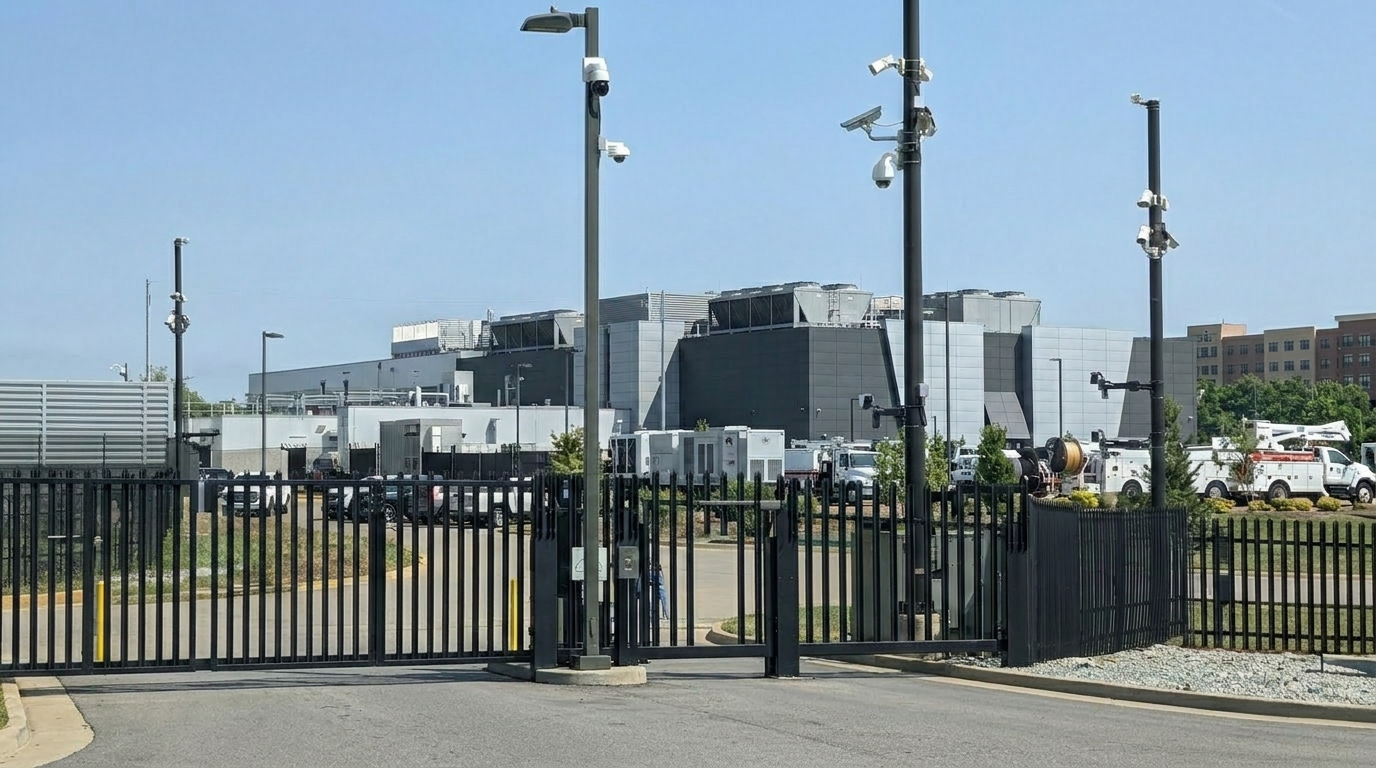
Modern data centers operate in mission critical environments where physical security failures can result in catastrophic operational, financial, and reputational damage. For one global data center and cloud services provider, perimeter security had become a growing operational risk.
Over a year, its legacy perimeter intrusion detection system generated hundreds of thousands of alarms. The excessive nuisance alerts created serious alarm fatigue security risks and ultimately masked two verified real intrusion events.
The organization needed a data center perimeter security solution capable of delivering high accuracy detection while dramatically reducing false alarms and operational burden.
The Challenge: Alarm Fatigue in Data Center Perimeter Security
Data center environments require:
- Continuous perimeter monitoring
- Accurate detection across large and varied terrain
- Minimal false positives
- Rapid verification workflows
- Seamless VMS integration
The existing perimeter intrusion detection system produced excessive nuisance alerts triggered by environmental conditions, terrain variation, wildlife, and non threat movement.
The result was alarm fatigue in security operations, where operators become desensitized to alerts due to high volume and low reliability.
In critical infrastructure environments, alarm fatigue is not simply inefficient. It creates measurable security exposure.
Why Traditional Perimeter Intrusion Detection Systems Fall Short
The data center evaluated nearly 20 perimeter technologies, including:
- Camera based video analytics
- Radar systems
- Thermal imaging platforms
- Fence vibration detection systems
- Legacy fiber based PIDS
Common limitations included:
- Lighting and weather dependency
- High nuisance alarm rates
- Environmental clutter sensitivity
- Complex terrain coverage gaps
- Limited object classification accuracy
Traditional perimeter intrusion detection systems often rely on pixel based motion analytics, vibration triggers, or two dimensional detection models. These approaches can struggle in complex data center environments with slopes, elevation changes, and varied terrain.
The organization required a solution capable of delivering reliable detection independent of lighting conditions and environmental noise.
The 3D LiDAR Security Architecture
The selected solution consisted of:
- Q-TRACK LR 3D LiDAR solution
- Full integration with the existing Video Management System
The flexible installation and configuration of the 3D LiDAR sensors enabled deployment across highly diverse terrain, including areas with varying elevations and slopes.
Unlike traditional camera or radar systems, 3D LiDAR security provides:
- True 360 degree volumetric coverage
- Lighting independent detection
- Zone based intrusion monitoring
- High precision object tracking and classification
- No recording of personal identifiable information
Each sensor provides coverage of up to 15,000 square meters, significantly reducing infrastructure requirements across large data center campuses.
12 Month Red Team Validation Program
To validate system resilience, the data center conducted an extensive 12-month evaluation program designed to defeat the perimeter security solution.
A team of veteran physical and cyber security personnel executed hundreds of intrusion scenarios, including:
- Jumping perimeter fencing
- Digging tunnels beneath lakes
- Attempting drone based obstruction techniques
- Multi angle coordinated breach attempts
Among nearly 20 technologies tested, Quanergy’s 3D LiDAR based system was the only solution to successfully pass the full evaluation.
This extended validation confirmed its suitability for mission critical data center perimeter security applications.
Measurable Results and False Alarm Reduction
The deployment produced immediate operational impact.
False Alarm Reduction
- Reduced alarm volume from hundreds of thousands over 12 months to fewer than 10 per day
- Greater than 95 percent reduction in nuisance alerts
This dramatic false alarm reduction eliminated alarm fatigue and restored operator confidence in perimeter alerts.
Detection Accuracy
- 95 percent object detection, tracking, and classification accuracy
- Successful detection of all verified intrusion attempts during validation
The solution delivered reliable threat identification without overwhelming operators with noise.
Operational and Financial Impact
- Reduced reliance on guard services
- Improved response efficiency
- Enhanced situational awareness
- Potential savings of millions annually through operational optimization
By shifting from reactive alerting to intelligent spatial detection, the data center significantly improved security return on investment.
Architectural Advantages for Large Scale Data Centers
The deployed 3D LiDAR security platform offers:
- Seamless integration between sensors and perception software
- Mesh networking for continuous tracking across large campuses
- Broad ecosystem compatibility with leading VMS platforms
- Augmentation of existing camera based perimeter intrusion detection investments
Rather than replacing infrastructure, the system enhances and refines perimeter detection accuracy.
For hyperscale and colocation data center operators, scalability and integration flexibility are critical. The LiDAR based architecture supports multi site deployment models and long term expansion.
Why 3D LiDAR Is Redefining Data Center Perimeter Security
As global data center infrastructure expands, perimeter security systems must evolve beyond legacy technologies.
3D LiDAR security offers:
- Volumetric detection instead of two dimensional pixel analysis
- Privacy compliant monitoring
- Terrain agnostic performance
- Reduced operational burden
- Superior false alarm reduction
For mission critical environments where uptime, compliance, and operational efficiency are paramount, advanced perimeter intrusion detection systems must prioritize accuracy over alert volume.
Frequently Asked Questions
What is alarm fatigue in security operations?
Alarm fatigue occurs when security operators are exposed to excessive nuisance alerts, leading to desensitization and delayed response to real threats. In data center environments, alarm fatigue security risks can significantly increase operational vulnerability.
Why is false alarm reduction important in data center perimeter security?
False alarm reduction improves operator efficiency, reduces guard costs, and ensures real threats receive immediate attention. In high security environments, accuracy is more valuable than alert volume.
How does 3D LiDAR differ from traditional perimeter intrusion detection systems?
Unlike camera or vibration based systems, 3D LiDAR security uses volumetric spatial detection to accurately identify and track objects regardless of lighting conditions. This significantly improves detection reliability and reduces nuisance alarms.
结论
For this global data center and cloud services provider, transitioning to a 3D LiDAR based perimeter intrusion detection system resulted in:
- Elimination of alarm fatigue
- Greater than 95 percent false alarm reduction
- High accuracy threat detection
- Improved operational efficiency
- Long term cost optimization
As critical infrastructure environments demand higher levels of performance and reliability, modern data center perimeter security strategies must move beyond legacy detection models.
3D LiDAR delivers the precision, scalability, and operational intelligence required to protect mission critical assets.
Similar LiDAR perimeter deployments have also been implemented to protect electrical substations and utility infrastructure environments where traditional perimeter detection technologies struggle with nuisance alarms.
