

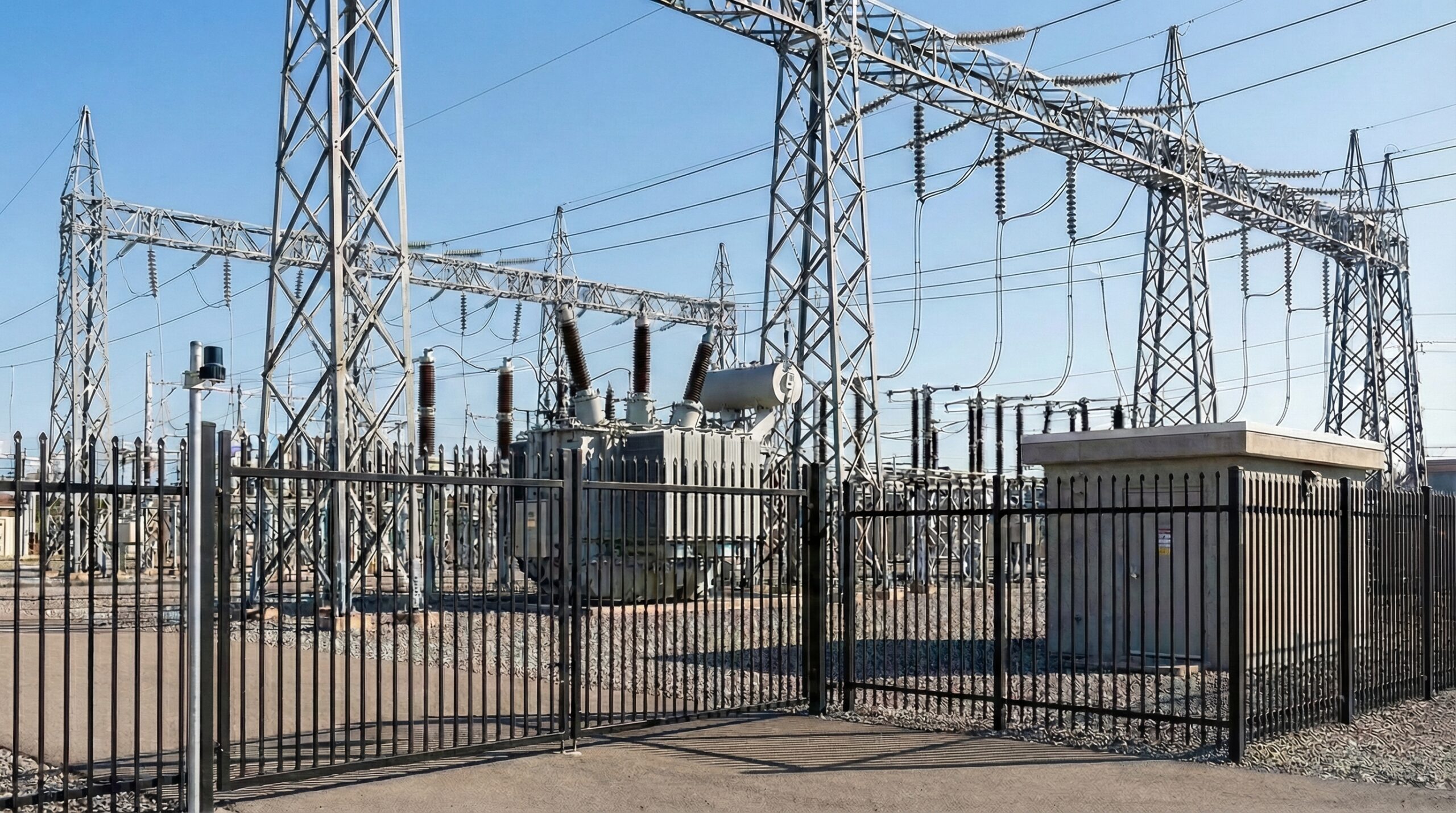
Substation Perimeter Security Case Study
Reducing False Alarms with a 3D LiDAR Perimeter Intrusion Detection System
Electrical substations are critical infrastructure facilities that require reliable perimeter protection to prevent unauthorized access, vandalism, and disruption to energy distribution. Traditional perimeter intrusion detection systems often struggle in environments where nearby activity generates frequent nuisance alarms.
A large energy provider operating a high-value electrical substation required a modern perimeter security solution capable of detecting real intrusions while dramatically reducing false alarms generated by its legacy perimeter intrusion detection system.
What Is a Perimeter Intrusion Detection System?
A Perimeter Intrusion Detection System (PIDS) is designed to detect unauthorized entry into secured areas such as electrical substations, data centers, airports, and industrial facilities. These systems monitor the perimeter boundary and alert operators when a potential intrusion occurs.
Modern perimeter intrusion detection systems using 3D LiDAR technology provide precise spatial awareness, allowing the system to accurately detect and track people or vehicles while filtering out environmental activity that would normally trigger false alarms.
Quick Deployment Summary
Industry
Energy and Utilities
Facility Type
Electrical Substation
Security Challenge
Frequent nuisance alarms from a legacy perimeter intrusion detection system caused by surrounding environmental activity.
Solution
Quanergy Q-TRACK™ 3D LiDAR Perimeter Intrusion Detection System
Technology
Q-TRACK LR 3D LiDAR sensors with real-time object detection and tracking
System Integration
Genetec Security Center VMS with ONVIF PTZ camera control
Key Result
False alarms were reduced to fewer than three alerts per day while maintaining continuous automated perimeter monitoring.
Challenge
The facility relied on an existing Perimeter Intrusion Detection System (PIDS) that generated a high volume of nuisance alarms. Security operators frequently had to investigate alerts that did not represent genuine security threats. This created alarm fatigue and reduced the effectiveness of the security operation.
The surrounding environment made perimeter monitoring particularly challenging. Nearby roadways produced constant vehicle movement. Pedestrian traffic occurred close to the facility perimeter, and surrounding off-site activity generated motion near the protected zone.
Traditional perimeter detection technologies lacked the spatial awareness necessary to differentiate between legitimate intrusions and harmless environmental activity. Passing vehicles, nearby foot traffic, and surrounding movement frequently triggered alarms that required investigation.
The energy provider required a more advanced perimeter intrusion detection system capable of accurately identifying real threats while filtering out irrelevant activity.
Why Radar Was Not Selected for This Deployment
Radar-based perimeter detection technologies are commonly used for large outdoor security deployments. However, radar systems can be sensitive to electromagnetic interference (EMI) generated by high-voltage electrical equipment commonly found in substation environments.
Electrical substations contain transformers, switchgear, and power transmission equipment that generate electromagnetic fields. In certain deployments, these conditions can impact the performance of radar-based detection systems, leading to inconsistent detection accuracy or nuisance alerts.
Because of these conditions, the project team evaluated alternative technologies that could operate reliably in high electromagnetic environments. 3D LiDAR sensors operate using laser-based optical detection rather than radio frequency signals, making them inherently immune to electromagnetic interference.
For this deployment, LiDAR provided a more stable detection platform while delivering precise three-dimensional object detection and tracking across the entire protected perimeter.
Solution
Quanergy deployed its Q-TRACK Real-Time 3D Security Intelligence platform, powered by multiple Q-TRACK LR 3D LiDAR sensors and advanced perception software.
Each LiDAR sensor provides 360-degree monitoring coverage with a detection range comparable to three football fields, allowing large outdoor areas to be protected with precise spatial awareness. Sensors were strategically installed around the facility perimeter and digitally meshed together to create continuous monitoring coverage.
This sensor mesh allows the system to detect, classify, and track objects in real time across the protected zone. Intruders can be continuously tracked as they move along the perimeter without blind spots.
The Q-TRACK platform was integrated directly with the customer’s Genetec Security Center video management system, enabling a seamless event-to-action workflow for security operators.
When an intrusion is detected, the system automatically sends real-time geolocation coordinates to nearby PTZ cameras using ONVIF-based camera control. Cameras immediately move to the detected location, allowing operators to visually verify the event.
This combination of LiDAR detection and automated camera response allows security teams to quickly determine whether detected activity represents authorized personnel, harmless environmental movement, or a genuine intrusion attempt.
Why LiDAR Improves Substation Perimeter Security
Electrical substations often operate in environments where vehicle traffic, pedestrian movement, and environmental activity occur near the facility perimeter. Traditional perimeter detection technologies frequently generate nuisance alarms under these conditions.
LiDAR-based perimeter intrusion detection systems provide precise three-dimensional spatial awareness. This allows the system to accurately distinguish between real intrusions and harmless environmental movement.
The result is improved detection accuracy, fewer nuisance alarms, and more efficient security operations.
Outcome
Following deployment of the Q-TRACK 3D LiDAR perimeter intrusion detection system, the facility experienced a significant improvement in perimeter security performance.
The system now provides continuous 24-hour automated monitoring with highly accurate detection across the entire substation perimeter.
False alarms were dramatically reduced. The system consistently generated fewer than three nuisance alerts per day, significantly outperforming the organization’s internal performance target.
Environmental activity that previously triggered alarms including vehicle traffic, pedestrian movement, and surrounding off-site activity was accurately filtered by the LiDAR-based detection platform.
With far fewer nuisance alerts, security operators can focus on genuine security events rather than responding to constant false alarms. This significantly reduced alarm fatigue and improved overall operational efficiency.
Today, LiDAR-based Perimeter Intrusion Detection Systems (PIDS) are increasingly used to protect critical infrastructure including substations, utilities, data centers, airports, and industrial facilities.
The deployment demonstrates how LiDAR-based perimeter intrusion detection systems can deliver reliable protection for critical infrastructure environments where traditional detection technologies struggle with nuisance alarms.
Technologies Deployed
- Q-TRACK 3D LiDAR Sensors
- Real-Time 3D Object Detection and Tracking
- Zone-Based Intrusion Detection
- Genetec Security Center Integration
- ONVIF PTZ Camera Integration
Frequently Asked Questions
Why do substations require perimeter intrusion detection?
Electrical substations contain critical infrastructure that supports power transmission and distribution. Unauthorized access can create safety risks and disrupt energy services. Perimeter intrusion detection systems allow operators to detect threats early and respond before intruders reach sensitive equipment.
How does LiDAR improve perimeter intrusion detection?
LiDAR sensors generate a high-resolution three-dimensional model of the monitored environment. This allows the system to accurately detect and track people or vehicles while distinguishing between real intrusions and harmless environmental movement.
This significantly reduces nuisance alarms compared to traditional perimeter detection technologies.
Can LiDAR perimeter security systems integrate with existing surveillance cameras?
Yes. Quanergy’s Q-TRACK platform integrates with various leading video management systems, including Genetec Security Center, and supports both ONVIF/native driver PTZ camera control. When an intrusion is detected, the system sends real-time coordinates to PTZ cameras, enabling them to slew to cue and automatically focus on the target location for rapid visual verification.
Why would you choose LiDAR over radar for perimeter security?
LiDAR and radar are both used in perimeter intrusion detection systems, but they operate using different sensing technologies.
Radar systems use radio frequency signals to detect movement across large areas. In environments such as electrical substations, electromagnetic interference from high-voltage equipment can sometimes impact radar performance.
LiDAR sensors use laser-based optical detection to generate a high-resolution three-dimensional model of the monitored environment. Because LiDAR does not rely on radio frequency signals, it is not affected by electromagnetic interference.
This allows LiDAR-based security systems to deliver highly accurate detection and tracking in complex environments while maintaining consistent performance.
Similar LiDAR perimeter deployments are also protecting large scale data center environments, where reducing nuisance alarms and improving detection accuracy are critical to security operations.
