

San Jose, CA — January 19, 2026
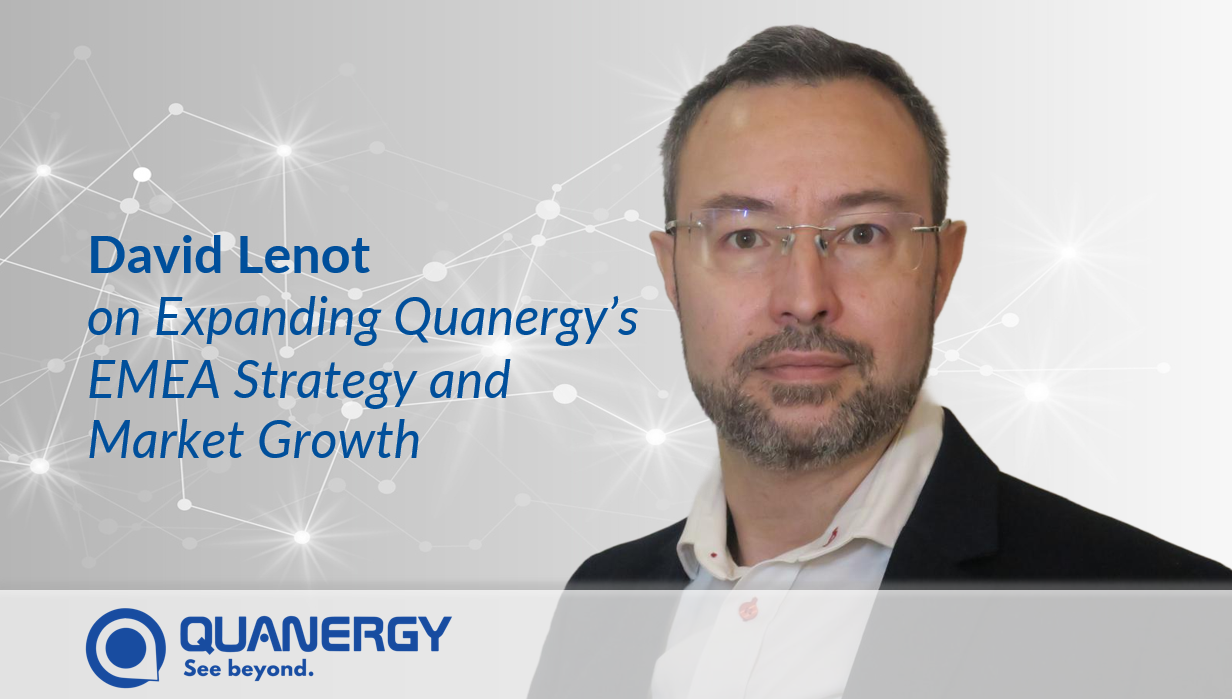
Following his appointment as Director, EMEA Sales & Market Development, we sat down with David Lenot to learn more about his professional background, his perspective on the evolving security and industrial landscape across EMEA, and what led him to join Quanergy at this stage of the company’s growth.
In the Q&A below, David shares insights into his experience, market outlook, and priorities as he begins his role with the company.
Background & Experience
Can you walk us through your professional background and the roles that most shaped your career?
My career has been shaped by a passion for bringing breakthrough technologies to market and helping partners and customers understand their real-world value. Over the past two decades, I’ve worked closely with manufacturers across EMEA to introduce the latest innovations, often acting as an evangelist to simplify technological concepts and translate complex capabilities into clear business outcomes.
A pivotal chapter was my time at VCS GmbH, where I helped pioneer video over IP and drove the early digital transformation of physical security. That experience taught me what it takes to shift an entire industry from legacy analogue systems to modern, network-based architectures — and how to guide partners and end users through that transition with confidence.
Living and working in five countries — France, Germany, the UAE, India, and the Netherlands — has also shaped my approach. It gave me a deep appreciation for cultural nuance, regional market maturity, and the importance of tailoring technology adoption strategies to local realities.
Across VCS, Bosch, Genetec, and now Quanergy, the common thread has remained the same: championing innovation, enabling partners to succeed, demonstrating true value to users/operators & owners, and building ecosystems that scale sustainably across diverse markets.
What types of markets or industries have you spent the most time working in across EMEA?
I’ve had the privilege of working across some of the most demanding and mission-critical industries in the region. This includes extensive work with major international airports supporting their digital transformation and modernizing security and operational workflows.
Beyond aviation, I’ve collaborated closely with rail networks, energy providers, and utilities, helping them transition toward smarter, more resilient, and data-driven operations. These sectors share a common need for technologies that deliver precise situational awareness, withstand harsh environments, and integrate seamlessly into complex infrastructures.
Across all these industries, the focus has always been on improving safety, efficiency, and operational intelligence through advanced sensing and innovative technology adoption.
Industry Perspective
From your perspective, how is the security, flow, and Industrial landscape evolving in EMEA?
The security landscape in EMEA is evolving at an unprecedented pace. While cybersecurity often dominates headlines, physical security — and particularly outer perimeter protection — has become a major point of attention for organizations across the region. Threats are becoming more sophisticated, more coordinated, and more difficult to detect with traditional technologies.
At the same time, critical infrastructure, transportation hubs, logistics centers, and industrial sites are under increasing pressure to operate with higher resilience and greater situational awareness. This shift is driving demand for sensing technologies that deliver real time accuracy, environmental robustness, and actionable intelligence — capabilities that legacy systems were never designed to provide.
What challenges do end users and integrators face today that traditional technologies struggle to solve?
Many of today’s limitations stem from the maturity level of traditional sensing technologies. For years, physical security relied on basic point intrusion detection systems that simply indicated where a breach occurred after it had already happened. Over time, the industry added the ability to capture an image of the event — for example, showing the hole in the fence — but this still represented a reactive posture.
Modern operations require far more. End users now expect:
- Presence detection and real-time tracking, enabling them to understand when a potential threat is approaching before an intrusion occurs
- Continuous people and object detection, not just binary alarms
- High-resolution, high-fidelity data that reduces false alarms and accelerates decision making
- Fast, accurate reconstruction of the entire incident, providing clarity, accountability, and operational insight
Traditional technologies — whether cameras, radar, or legacy sensors — were never designed to deliver this level of precision, context, or predictive capability. This gap is exactly where advanced LiDAR-based perception systems are transforming the landscape.
Where do you see the biggest growth opportunities for advanced LiDAR technologies in the region?
The growth opportunities for LiDAR in EMEA are directly tied to the ability of vendors to deliver tangible, ready to consume solutions that demonstrate clear operational outcomes. The market is no longer satisfied with promising technology — it wants measurable impact.
The strongest opportunities fall into three major categories:
1. Organizations are looking to move beyond reactive alarms toward proactive, intelligence-driven security. LiDAR enables:
- Early detection at the perimeter, identifying threats before an intrusion occurs
- Real-time tracking of people and objects, even in complex or cluttered environments
- High accuracy monitoring in small or sensitive spaces, where understanding interactions between people and high-value assets is critical
This shift from “point intrusion detection” to continuous situational awareness is one of the most significant drivers of LiDAR adoption.
2. Operational excellence and improved customer experience
Beyond security, LiDAR is becoming a key enabler of operational efficiency. Organizations can use LiDAR-based flow analytics to:
- Manage people and vehicle movement
- Reduce wait times and congestion
- Optimize resource allocation
- Improve service levels and customer satisfaction
This is especially relevant in airports, logistics hubs, rail stations, and large public venues where flow management directly impacts both cost and experience.
3. Unlocking unique 3D-driven outcomes that only LiDAR can deliver
LiDAR’s true differentiator is its ability to generate precise, real-time 3D spatial data. This opens the door to outcomes that traditional sensors simply cannot support, such as:
- Feeding digital twin models with accurate, real-time spatial information
- Enhancing industrial safety, for example, detecting people around large moving cranes in ports or heavy equipment zones
- Supporting advanced automation and robotics with reliable 3D perception
These capabilities are creating entirely new categories of value — not just improving existing workflows, but enabling use cases that were previously impossible.
Decision to Join Quanergy
What initially caught your attention about Quanergy?
Over the past seven years, I’ve been deeply involved in building products and solutions that made a real difference for critical infrastructure, data centers, and airport perimeter protection. That work exposed me to a wide range of sensing technologies — cameras, radar, thermal, analytics, and more. Each brought value, but across all these options, LiDAR consistently delivered a unique set of capabilities in terms of accuracy, reliability, and environmental independence.
But one thing became very clear: LiDAR alone is not enough. A sensor without perception, context, and applications remains just a component.
What immediately caught my attention about Quanergy is that the company understands this better than anyone. Quanergy doesn’t just offer LiDAR — it delivers LiDAR + perception + applications in a unified platform. That combination transforms raw 3D data into actionable intelligence, enabling real world outcomes that traditional technologies simply cannot match.
This end to end approach is exactly what the market has been waiting for, and it’s what made Quanergy stand out as the right place for the next chapter of my career.
Why was now the right time for you to join the company?
The EMEA market is at an inflection point. End users are actively seeking alternatives to legacy sensing technologies, and LiDAR has moved from “interesting” to “essential.” Quanergy is uniquely positioned to lead this shift, and the opportunity to build the EMEA presence from the ground up aligns perfectly with my experience and passion for market development.
How do you see Quanergy’s LiDAR-based approach standing apart from other technologies in the market?
Quanergy differentiates itself through:
- Unmatched accuracy and reliability, even in challenging environments
- A complete perception stack, combining hardware and advanced 3D analytics
- A focus on real world outcomes, not just technical specifications
This combination enables Quanergy to deliver capabilities that cameras, radar, and legacy sensors cannot match.
Role & Vision
In your new role, what are your top priorities for EMEA over the next 6–12 months?
My top priority is to ensure that working with Quanergy is completely frictionless — for integrators, end users, and maintenance teams alike. That means delivering a seamless experience across the entire lifecycle:
- From contracting to deployment, ensuring clarity, speed, and predictability
- From configuration to operations, making our solutions easy to set up, easy to integrate, and easy to maintain
- Across every touchpoint, removing complexity so partners can focus on delivering value rather than managing technology hurdles
Alongside this, I’m focused on building a strong regional ecosystem, accelerating lighthouse deployments, and establishing a scalable operational framework that supports long term growth. But at the core, it’s about making Quanergy the easiest advanced sensing partner to work with in the industry.
How do you approach building strong partner ecosystems across diverse regions?
Success in EMEA requires cultural sensitivity, local relevance, and long-term commitment. I focus on:
- Selecting partners who share a vision for innovation
- Providing clear enablement, training, and go-to-market support
- Building trust through transparency and consistent execution
- Co-creating solutions that address regional needs
A strong ecosystem is built on shared success, not transactions.
Personal Insight
What excites you most about working with emerging technologies like 3D LiDAR?
What excites me most is how LiDAR is redefining what digitization actually means. For years, we’ve talked about digital transformation, but LiDAR is enabling it in a way that is far easier, more granular, and more efficient than anything that came before.
With video, you can digitize infrastructure — think of something like Google Street View. But LiDAR goes far beyond that. It allows us to digitize the entire environment in real time, including every moving object, every interaction, and every change in the scene.
That’s a game-changer.
We’re no longer limited to static snapshots or post-event analysis. LiDAR gives us a live, dynamic digital representation of the world — one that can power automation, enhance safety, optimize operations, and unlock entirely new applications.
Being part of a technology that turns the physical world into actionable, real-time digital intelligence is incredibly energizing. It’s not just an evolution; it’s a fundamental shift in what’s possible.
