

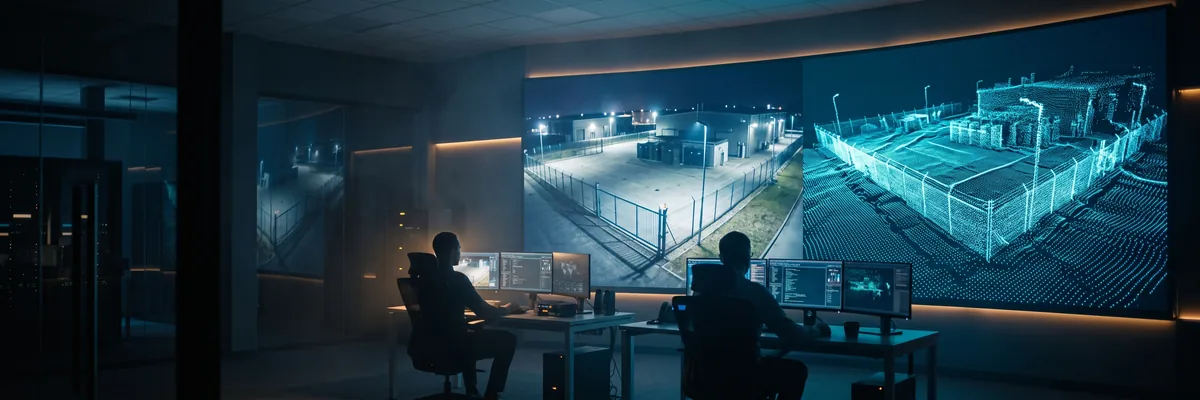
- Uptime is in the SLA, and physical security is part of uptime.
- 3D LiDAR cuts nuisance alarms: one global data center went from hundreds of thousands a year to fewer than 10 per day.
- The same platform covers construction sites, doors and mantraps, and racks and cages, in any light.
Data centers demand more than legacy surveillance cameras or badge-based access systems to protect their assets. Uptime is non-negotiable, and physical security is now part of the SLA. Yet the systems most sites rely on were built for a different job: cameras need light, fence sensors react to wind and wildlife, and badge readers count credentials, not people.
This post covers the security challenges data centers face today, how 3D LiDAR for data centers addresses them, and six use cases where operators see results.
Why data center security is getting harder
Demand for AI capacity is driving record construction. CBRE reports 7,481 MW of data center capacity under construction in North America in the first half of 2026. The data center physical security market is projected to grow from USD 2.2 billion in 2025 to USD 5.6 billion by 2032, according to P&S Intelligence.
Security headcount does not grow at that rate. Teams are asked to cover larger campuses, more buildings and active construction with the same operators. Four challenges come up again and again:
- Alarm fatigue. More cameras and fence sensors generate more alarms to clear, and real threats get buried in the noise.
- Perimeters where fencing is impractical or changing. Buildouts next to live halls change the perimeter every phase.
- Tailgating and piggybacking. Zero-tolerance policies require proof of who entered, not just which badge was used.
- Protecting what sits past the door. Racks, cages, fiber conduits and cooling equipment are the highest-value assets on site.
The cost of alarms nobody trusts
Every unseen breach, overlooked blind spot and ignored false alarm is a risk to uptime. At one global data center and cloud services provider, a legacy perimeter system produced hundreds of thousands of alarms over 12 months. Operators became desensitized, and the noise masked two verified real intrusions.
The provider ran a 12-month red team evaluation of nearly 20 technologies with hundreds of intrusion scenarios. Quanergy was the only solution to pass the full evaluation. After deploying Q-TRACK LR sensors integrated with its existing VMS, the results were:
Read the full data center perimeter security case study.
How 3D LiDAR works for data center security
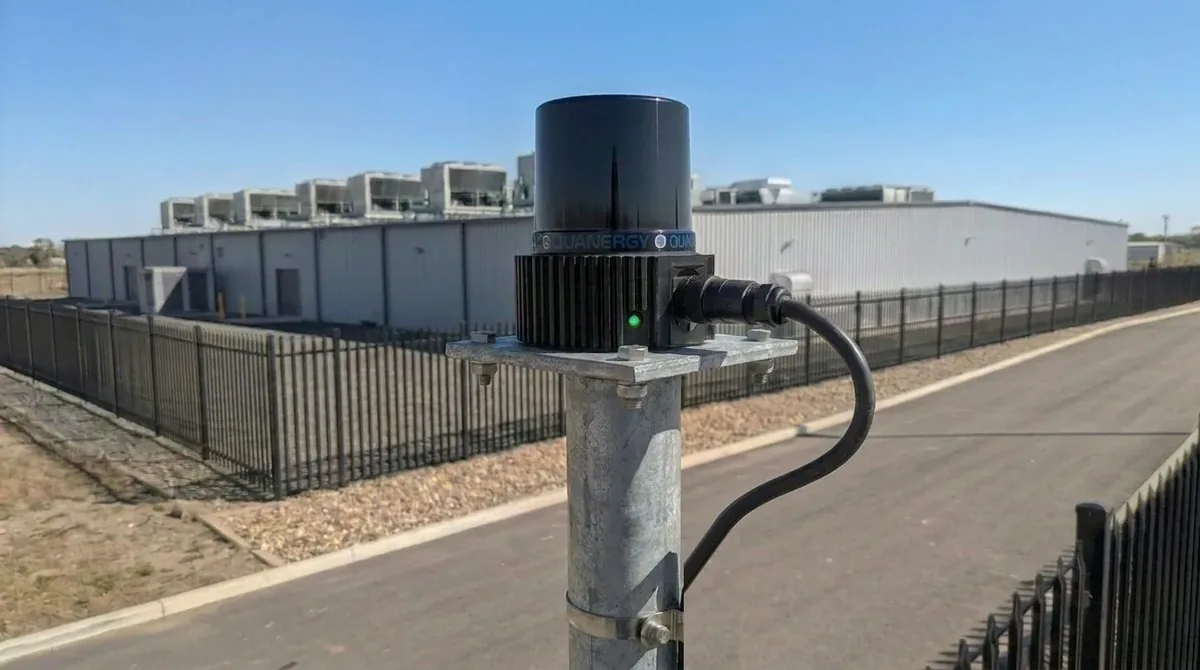
LiDAR sends out laser pulses and measures their return to build a live 3D model of the scene. Q-TRACK processes millions of 3D points per second, and QORTEX DTC perception software works in four steps: detect, track, classify, alert. It detects every object in the scene, tracks it with centimeter-level position, speed and direction, classifies it as a person or vehicle by its size and movement, and alerts only when a real object enters a zone. Weather and vegetation do not raise alarms.
Three properties make it a fit for data centers:
- It works in total darkness. LiDAR brings its own light, so detection does not depend on floodlights or time of day.
- It covers wide areas. A 360° field of view and up to 15,000 square meters per Q-TRACK LR sensor reduce blind spots and pole count.
- It measures space, not pixels. Every person and vehicle gets a real 3D position, speed and direction, so zones and distances are set in meters and alarms land on the right camera view in your VMS.
Six data center use cases for 3D LiDAR
1. Perimeter intrusion detection with fewer nuisance alarms
Detect and classify people and vehicles at the fence line in any weather. Fewer, better alarms mean the SOC spends its time on real events, as the case study above shows.
2. Construction site security
Buildouts bring theft, trespass and a perimeter that moves every phase. Q-TRACK creates 3D virtual perimeters that are redrawn in software as the site changes, protecting equipment and materials without slowing the schedule.
3. Anti-tailgating at doors and mantraps
A badge read proves a credential was used. It does not prove how many people walked through. At entries where access control or security entrances are deployed, 3D counting on every door or mantrap cycle detects tailgating, piggybacking, multi-pass entry and shadowing.
4. Critical asset and cage protection
Most security spending stops at the door. Q-TRACK sends real-time alerts when anyone approaches racks, cages, fiber conduits or HVAC equipment without authorization, and flags off-hours presence in sensitive rooms. In colocation spaces, each tenant’s racks and cages are monitored within their own allocated zone.
5. After-hours monitoring
Quiet hours and weekends are when perimeters are most exposed and least watched. LiDAR brings its own light, so 3D detection keeps full awareness in total darkness.
6. Virtual perimeters for fence lines, gates and rooftops
Set invisible 3D boundaries along fence lines, gates, rooftops, ladders, hatches and cooling assets. Real-time alerts fire the moment someone climbs, cuts, tosses or loiters.
Layered security, from the fence to the rack
Data centers depend on layers. 3D LiDAR adds detection at each one and feeds a single SOC:
- Perimeter: detect threats before they reach critical areas.
- Secured entry points: catch tailgating and piggybacking at doors and mantraps.
- White space: alert on unauthorized presence near racks and cages.
- Emergency response: live occupancy views speed evacuations and mustering.
Q-TRACK integrates with leading VMS and security platforms, including Advancis, Bosch/IQSIGHT BVMS, exacqVision, Hirsch Velocity, IntelliCene / Symphia Control, Milestone XProtect, Motorola Avigilon Unity, Network Optix, Salient CompleteView and Teledyne FLIR, plus many more not listed here, so you upgrade detection without overhauling your existing systems.
Security for any size data center
- Hyperscale: expansive, high-accuracy coverage for vast perimeters without blind spots.
- Colocation: precise segmentation, so each tenant’s racks and cages are monitored within their allocated space.
- Enterprise and private: the highest level of security for critical business operations and government data.
- Edge: protection for smaller, remote or unmanned sites where traditional measures fall short.
Lower total cost of ownership
Fewer false alarms mean fewer dispatches and less operator time spent clearing noise. Wide coverage per sensor means fewer devices to install and maintain. And because zones live in software, the same platform can follow a site from construction into operation.
Explore the full use case set on our data center security page, see the Q-TRACK product line, or browse more security applications.
Sources: CBRE, North America data center report, H1 2026; P&S Intelligence, Data Center Physical Security Market; Quanergy data center case study.
See every threat. Protect the nines.
Tell us about your campus, buildout or secure areas. We will map where 3D LiDAR cuts nuisance alarms and closes blind spots.